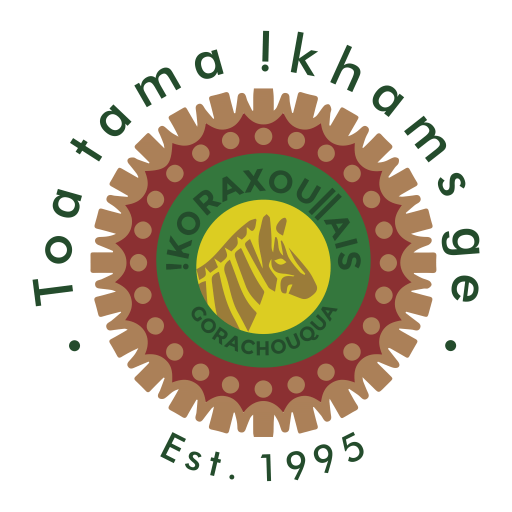
The Quagga was the only animal that could only be found in the Western Cape and nowhere else in South Africa. The Western Cape is also the land where the Gorachouqua, as a Tribe of the Indigenous People, settle thousands of years ago. Both man and animal shared the same land. The Quagga is facing forward, looking to the future, urging the Gorachouqua Tribe to Unite, Build and move forward into the future.
The Gold represent the rich natural resources of the land and rich culture of the Tribe. The Green represents the land itself.
The Red represents the blood shed by our ancestors and the genocide committed towards them. It also refers to the colour of the many paintings that can be found in the caves where they lived. The People holding hands represents the Unity and Strength of the Gorachouqua Tribe. The People are looking outwards – which represents the People protecting the Tribe and keeping it together and also defending it from any external threats. The Brown represent the colour of the skin of the people of the Tribe as well as the colour of the land. This also emphasises the bond and relationship between man and soil. The Entire Crest resembles a fynbos flower which is also indigenous to the Western Cape.
Vision & Mission
Vision
The tribe seeks to teach, uphold and promote the heritage, traditions and culture of the Tribe as a member of the greater Khoekhoe and Bushman Nation.
Mission
To achieve the national advancement of the tribe and to establish, conduct and supervise standards, values and norms pertaining to the practices of the Tribe.
"promote the heritage traditions and culture"
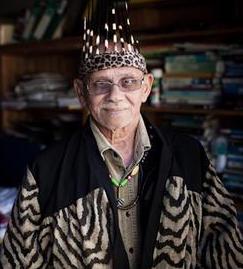
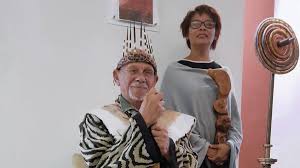
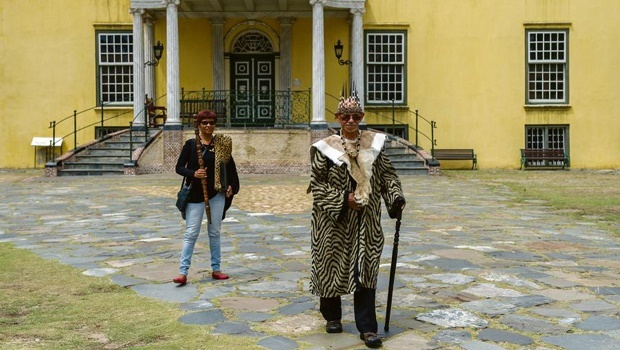
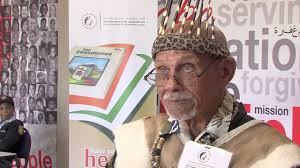
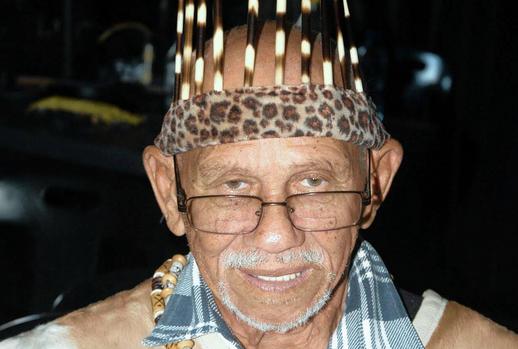
Chief Hendrik ‘Hennie’ van Wyk
Hendrik ‘Hennie’ van Wyk was born in Vredendal, Cape Province (now Western Cape) on 14th July 1936. His childhood witnessed the final days of colonial rule and the transition to the apartheid regime in 1948, and in 1950, he and his family were forced to register as Coloured, according to the Population Registration Act.
In 1951, at the age of fourteen, he moved to Cape Town to continue his education at Wellesley Training College, as there had been no high schools in his home area for Coloured individuals. He remained in this school until Grade Ten, when he left for economic reasons in 1955. His Grade Ten exams were the last integrated examinations in the apartheid period – after that, examinations and curriculums in South Africa were segregated by race. During this period in Cape Town, Van Wyk boarded with a Mr and Mrs Lewin, a highly political couple under whose guidance he was first exposed to a political education, and as a teenager, he delivered African National Congress (ANC) newspapers, The New Age and The Torch.
Van Wyk is currently working towards recognition of Khoisan indigenous rights in South Africa, although his focus is on cultural recognition and promotion, as opposed to any ethnic division. He is keen to use research into Khoi history and identity, including various writings on early colonial explorations of South Africa, to work out a written history of its indigenous peoples, which he feels has heretofore been neglected and ignored. His central concerns – and the concerns of many of his contemporaries – centre on the recognition of land and language rights, which they believe to be central to Khoisan identity in post-apartheid South Africa. Such rights, he argues, should be granted to the Khoisan peoples under the UN declaration of 2007 on indigenous rights, which have not been fully implemented in South Africa. Along with various others, he is currently busy with a court case against the government for cultural genocide, although the case is struggling with a lack of financial resources, limiting its likelihood of success at present. Nevertheless, steps are now beginning to be taken towards the recognition of Khoisan identity in South Africa.